Read a mattress spec sheet and you will run into a dozen unfamiliar terms in one paragraph. Viscoelastic foam. Pocket coils. GOLS-certified latex. A fire barrier. Most shoppers skip straight to firmness and price and never learn what is actually layered beneath them — until a headline about fiberglass contamination sends them digging through the tag on their own mattress. This guide breaks down every material you will find in a modern mattress, what each one does, and how to read a spec sheet the way someone in the industry does, including the one distinction — fiberglass versus polyester in the fire barrier — that has generated more reported complaints than any other mattress material in recent years.
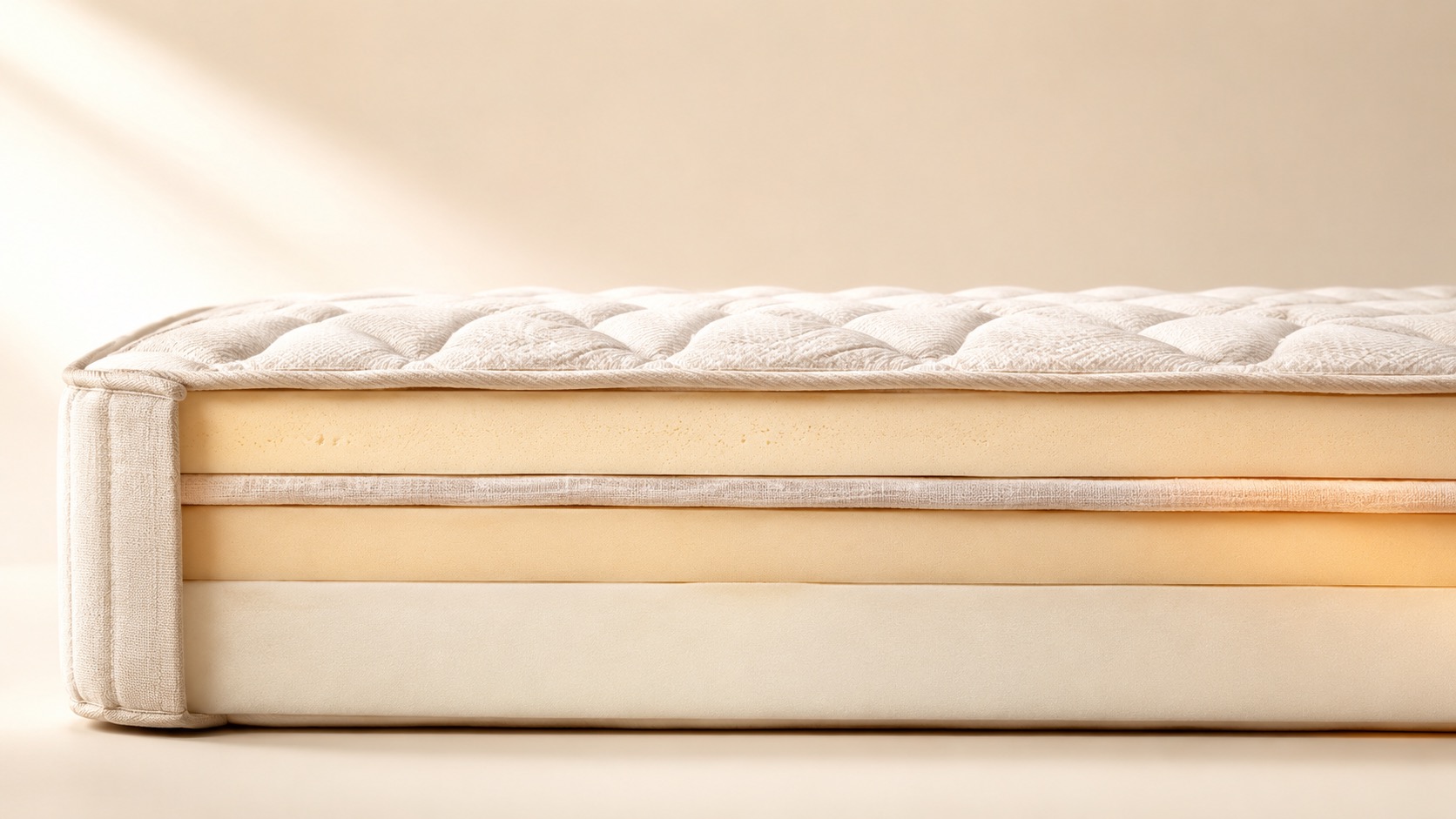
Quick Answer. The Anatomy of a Mattress
Nearly every mattress, regardless of brand, is built from the same stack of roles:
- Cover: Quilted, breathable fabric — the layer you touch
- Comfort Layer: Memory foam, latex, or gel foam — pressure relief and feel
- Transition Layer: Medium-density foam that bridges comfort and support
- Support Core: High-density foam or pocket coils — keeps you from bottoming out
- Fire Barrier: A federally required layer beneath the cover. SleepyEdge uses a polyester fire barrier, not fiberglass
What Is a Mattress Made Of? A Layer-by-Layer Breakdown
Strip any mattress down to its construction and you will find the same handful of roles repeated, no matter whether it is memory foam, latex hybrid, or innerspring. The cover is the quilted fabric you actually feel and sleep on — usually a blend chosen for breathability and durability rather than support. Beneath it sit one or more comfort layers, the foam or latex that contours to your body and relieves pressure at the hips and shoulders. Next is a transition layer, a medium-density foam that keeps the softer comfort layers from sinking straight into the firmer support below. The support core — high-density foam or a pocket coil system — is what actually holds your body weight and keeps the mattress from sagging over years of use. Underneath all of it, sewn just beneath the cover, is a fire barrier: a layer every mattress sold in the U.S. is required to have, engineered specifically to resist open-flame ignition.
What changes from mattress to mattress is which specific materials fill each role — and that is where price, feel, and durability actually diverge.
Foam Types Explained: Memory Foam, Latex, and High-Density Support Foam
Memory Foam
Memory foam is a viscoelastic polyurethane foam that slowly softens under body heat and weight, contouring to your shape before recovering once you move. It is prized for pressure relief and motion isolation — a partner shifting positions on one side of the bed barely disturbs the other. SleepyEdge's Ground™ and Ground Pro™ both use a viscoelastic cool gel memory foam comfort layer, the Attune™ uses a copper gel memory layer for targeted cooling, and the Attune Pro™ builds its top comfort layer from bio-based memory foam.
Latex Foam
Latex is a naturally open-cell material, typically tapped from rubber trees and processed into a foam that is more responsive than memory foam — it contours instantly and springs back the moment you move, rather than slowly softening. That open-cell structure also makes it more breathable, so latex mattresses generally sleep cooler than dense memory foam. When a latex layer is GOLS certified (Global Organic Latex Standard), it means the latex has been independently verified as made from a required percentage of certified-organic raw material and processed to defined environmental and labor standards. SleepyEdge's Elevate™ and Elevate Pro™ both use a GOLS-certified organic natural latex comfort layer.
High-Density Support Foam
This is the workhorse layer most shoppers never think about, and the one that determines how long a mattress actually lasts. Higher-density support foam resists compression over years of nightly use, while low-density foam in cheaper mattresses tends to develop body impressions and sag well before the decade mark. SleepyEdge's Ground™ uses a firm bio foam support core, and the Ground Pro™ steps up to a high-resilience bio foam core for a firmer, longer-lasting base.
Pocket Coils and Hybrid Construction: When Springs Make Sense
A hybrid mattress pairs foam or latex comfort layers with an innerspring support core, and modern hybrids use pocket coils rather than the old interconnected coil systems. Each coil is individually wrapped in its own fabric pocket, so it compresses independently instead of pulling on the coils around it — that is what lets a hybrid isolate motion nearly as well as foam while adding responsiveness and airflow that pure foam cannot match. Zoned pocket coil systems go a step further, using firmer coils under the hips and softer coils under the shoulders for support that matches the body's actual pressure map.
SleepyEdge's Elevate™ and Elevate Pro™ both build on a 5-zone high-density pocket coil system, and the Attune™ and Attune Pro™ use a 5-zone pocket coil core with foam-encased edges for added lateral support at the perimeter of the bed.
Wool, Cotton, and Other Natural Fill Materials
Natural fibers show up in premium mattresses as comfort and climate-regulating materials, not as structural support. Wool naturally wicks moisture and regulates temperature, which is why it often appears in a top comfort layer rather than deep in the mattress. Cotton, especially when heat-treated, adds a breathable, low-static layer directly under the cover. SleepyEdge's Attune Pro™ layers in a wool dacron foam and a heat-treated white cotton pad alongside its memory foam, which is part of why it is positioned as SleepyEdge's most luxurious build.
Fire Barriers and Fire Retardants: What's Actually Inside Your Mattress
Every mattress legally sold in the United States — regardless of brand, price, or materials — must include a fire barrier layer sewn beneath the cover. This is not a brand choice; it is a federal requirement. The U.S. Consumer Product Safety Commission's open-flame flammability standard (16 CFR Part 1633) requires every mattress set to limit the size and growth rate of a fire during a 30-minute open-flame test. How a manufacturer meets that standard, however, varies widely — and that variation is where the fiberglass issue comes from.
Fiberglass is a woven glass-fiber fabric that some manufacturers, particularly mass-market and budget brands, have used as a fire barrier because it is inexpensive and effective at slowing ignition. The problem is not the barrier doing its job inside a sealed mattress — it is what happens if the cover is ever unzipped and removed. Some mattress covers appear removable or washable but are not designed to come off, and consumers who have removed one over a fiberglass barrier have reported fine glass particles escaping and contaminating the surrounding room, along with skin, eye, and respiratory irritation from contact with the fibers. These are reported consumer complaints and regulatory findings, not a diagnosis — but they are widespread enough that California signed a law (AB 1059) banning the sale of mattresses containing textile fiberglass, effective January 1, 2027.
Fiberglass is not the only way to meet the federal standard. Wool, silica-treated rayon, and high-melt-point synthetic fabrics — including polyester — all satisfy the same 16 CFR 1633 requirement without the loose-particle contamination risk. A polyester fire barrier is a tightly woven, high-melt-point fabric sewn as a solid layer directly beneath the cover. It resists ignition the same way fiberglass does, but because it is a woven textile rather than loose glass fiber, there is nothing to shed or become airborne if the cover is ever removed.
Every mattress in the SleepyEdge collection uses a polyester fire barrier, not fiberglass — Ground™, Ground Pro™, Elevate™, Elevate Pro™, Attune™, and Attune Pro™, plus the HybriPure™ partner model. It is built in the same way across the full line, so the choice of comfort layer or support system does not change how any mattress meets its fire-safety requirement.
How to Check What Fire Barrier Is in Your Own Mattress
Every mattress sold in the U.S. is required to carry a white law tag sewn into a seam, disclosing the materials used to meet the flammability standard. Check that tag first. If it does not make the fire barrier material clear, contact the manufacturer directly rather than unzipping the cover to look — removing the cover is the step that can release particles if the barrier underneath does turn out to be fiberglass.
Certifications That Actually Matter: CertiPUR-US, GOLS, and UL
Mattress marketing is full of vague claims. Third-party certifications are the difference between a claim and a checkable fact, because an independent lab — not the manufacturer — is the one testing and issuing them.
- CertiPUR-US® certifies that foam has been independently tested and verified free of harmful chemicals, heavy metals, and ozone-depleting substances, and that it meets standards for low VOC emissions and durability. Every SleepyEdge mattress uses CertiPUR-US certified foam throughout, and every SleepyEdge mattress is completely fiberglass-free.
- GOLS (Global Organic Latex Standard) certifies that a latex layer is made from certified-organic raw material and processed to defined environmental and labor standards. SleepyEdge's Elevate™ and Elevate Pro™ latex comfort layers are GOLS certified.
- UL testing is independent third-party safety testing from Underwriters Laboratories, one of the oldest product-safety testing organizations in the country. SleepyEdge mattresses are UL tested as part of the same quality-verification process.
The Materials in Every SleepyEdge Mattress
Here is the exact comfort and support construction for each model in the SleepyEdge line — every one uses the same polyester fire barrier described above — so you can compare them the same way you would compare any spec sheet.
| Mattress | Comfort Layer(s) | Support System |
|---|---|---|
| Ground™ | Viscoelastic Cool Gel Memory Foam, Body Impression Foam | Firm Bio Foam Core |
| Ground Pro™ | Viscoelastic Cool Gel Memory Foam, Plush / Firm Foam | High Resilience Bio Foam Core |
| Elevate™ | GOLS-Certified Natural Latex, Plush Comfort Foam | 5-Zone High-Density Pocket Coil |
| Elevate Pro™ | GOLS-Certified Natural Latex, Plush Comfort Foam, Lumbar Support Layer | 5-Zone High-Density Pocket Coil |
| Attune™ | Copper Gel Memory Layer, Body Impression Layer | 5-Zone Pocket Coil, Foam-Encased |
| Attune Pro™ | Bio-Based Memory Foam, Wool Dacron Foam, High-Density Soft Foam, Heat-Treated Cotton Pad | 5-Zone Pocket Coil, Foam-Encased |
| HybriPure™ | Breathable Hybrid Foam Comfort Layer | Responsive Support System |
HybriPure™ is SleepyEdge's partner model, built to the same CertiPUR-US certified and polyester-fire-barrier standard as the core line. Not sure which combination fits how you sleep? The side-by-side comparison lays out feel and materials for every model at once, and every mattress ships with a 120-night trial so you can confirm the feel works in your own bedroom before committing.
The Bottom Line
A mattress is only as good as what is layered inside it — and the material that matters most for safety is the one shoppers see least: the fire barrier. Fiberglass isn't the only way to meet the federal flammability standard, and it isn't the way SleepyEdge builds. Every SleepyEdge mattress uses a polyester fire barrier, CertiPUR-US certified foam throughout, and — on the Elevate™ and Elevate Pro™ — a GOLS-certified organic latex layer. Read the spec sheet, check the law tag, and you should never have to guess what you are actually sleeping on.
Explore the Collection →Frequently Asked Questions
What is a mattress made of?
A modern mattress is built in layers: a quilted cover, one or more comfort layers (memory foam, latex, or gel foam), a transition layer, a support core (high-density foam or pocket coils), and a fire barrier sewn beneath the cover to meet federal flammability requirements. The exact materials vary by brand and model, but nearly every mattress follows this same layered structure.
What's the difference between memory foam and latex?
Memory foam is a viscoelastic material that slowly contours to your body heat and weight, then recovers its shape. Latex is a naturally open-cell, more responsive material that contours instantly and springs back immediately when you move. Memory foam typically isolates motion better; latex typically sleeps cooler and feels more buoyant.
Do all mattresses contain fiberglass?
No. Every mattress sold in the U.S. must include a fire barrier layer to meet federal open-flame flammability standards, but fiberglass is only one way manufacturers meet that requirement. Wool, silica-treated rayon, and high-melt-point synthetic fabrics such as polyester are common non-fiberglass alternatives that satisfy the same federal standard.
How can I tell if my mattress has a fiberglass fire barrier?
Check the white law tag sewn into the mattress seam — federal law requires it to disclose the fire-retardant materials used inside. If you are unsure, contact the manufacturer directly rather than unzipping or removing the cover, since that is the step that can release fiberglass particles if the barrier underneath contains them.
Does SleepyEdge use fiberglass in its mattresses?
No. Every mattress in the SleepyEdge collection, including the HybriPure partner model, uses a polyester fire barrier, not fiberglass. It is sewn as a solid, high-melt-point fabric layer beneath the cover, so there are no loose glass fibers that can escape if the cover is ever removed.
What does CertiPUR-US certification actually test for?
CertiPUR-US certification means an independent lab has tested the foam and confirmed it is made without harmful chemicals, heavy metals, or ozone-depleting substances, and that it meets standards for low VOC emissions and durability. Every SleepyEdge mattress uses CertiPUR-US certified foam throughout.