There are five ways a mattress gets built, and the type decides how it feels far more than any spec sheet does. All-foam is the most affordable and isolates motion best. A foam hybrid adds a coil support system underneath foam for more airflow. Latex-on-foam trades foam's slow "hug" for a buoyant, quick-response feel without any coils. Latex-on-coil hybrid combines that same latex responsiveness with a coil system for what is usually the coolest, bounciest build. Memory-foam-on-coil hybrid keeps a close, contouring feel while adding coil-based airflow and edge support. This guide compares all five head to head, gives the comparison most shoppers start with (memory foam versus hybrid) its own side-by-side breakdown, explains why two latex mattresses can feel noticeably different depending on what sits underneath, and shows which Sleepy Edge models fit which type.
The Quick Answer: Match a Type to Your Priority
- Best value / motion isolation: All-Foam
- Balanced feel at a lower price: Foam Hybrid
- Responsive latex feel, no coils: Latex-on-Foam
- Coolest, bounciest build: Latex-on-Coil Hybrid
- Contouring comfort with coil airflow: Memory-Foam Hybrid
The 5 Mattress Construction Types, Compared
Every mattress on the market is built from some combination of these five approaches. Here is how they stack up on the factors that actually change how a mattress feels each night.
| Type | Feel | Cooling | Motion Isolation | Price Tier |
|---|---|---|---|---|
| All-Foam | Close, contouring | Warmest | Best | Most affordable |
| Foam Hybrid | Balanced | Moderate | Good | Mid-range |
| Latex-on-Foam | Buoyant, quick-response | Cooler | Good | Mid-to-upper |
| Latex-on-Coil Hybrid | Buoyant, bouncy | Coolest | Good | Premium |
| Memory-Foam Hybrid | Contouring, plush | Cool | Good | Premium |
All-Foam vs. Foam Hybrid
All-foam mattresses are built entirely from layered foam — a softer comfort layer over a firmer, high-density support core — with no coils anywhere in the build. That simplicity is what makes them so consistent: foam has nowhere to flex or shift the way a coil does, so it isolates motion very well and holds a stable shape from edge to edge. It is also the most affordable construction, and the warmest, since there is less airflow through a solid slab of material than through a coil system.
A foam hybrid keeps a foam comfort layer but pairs it with a more responsive support system underneath, aiming for a middle ground between all-foam's value and a full coil-based hybrid's airflow — without the added cost of a true pocket coil system. It is the right pick if you want a step up from all-foam's warmth without paying for a latex or coil upgrade.
Latex-on-Foam vs. Latex-on-Coil Hybrid
Both of these types use a natural latex comfort layer, and latex behaves the same way in either build: it responds to pressure almost instantly, pushing back rather than slowly sinking the way memory foam does, and its open-cell structure breathes better than dense foam. What changes is what sits underneath that latex layer — and that difference is what you feel each night.
A latex-on-foam mattress sits its latex comfort layer on a high-density foam support base, with no coils. You get latex's signature responsiveness and breathability in a quieter, more affordable build that still isolates motion better than a coil-based mattress.
The Elevate™ and Elevate Pro™ line sits the same style of latex comfort layer on a 5-zone pocket coil support system instead. The coils add airflow the foam base cannot match, a firmer and more usable edge for sitting on, and an extra layer of bounce beneath the latex's own responsiveness. It is the coolest-sleeping construction across the entire Sleepy Edge line.
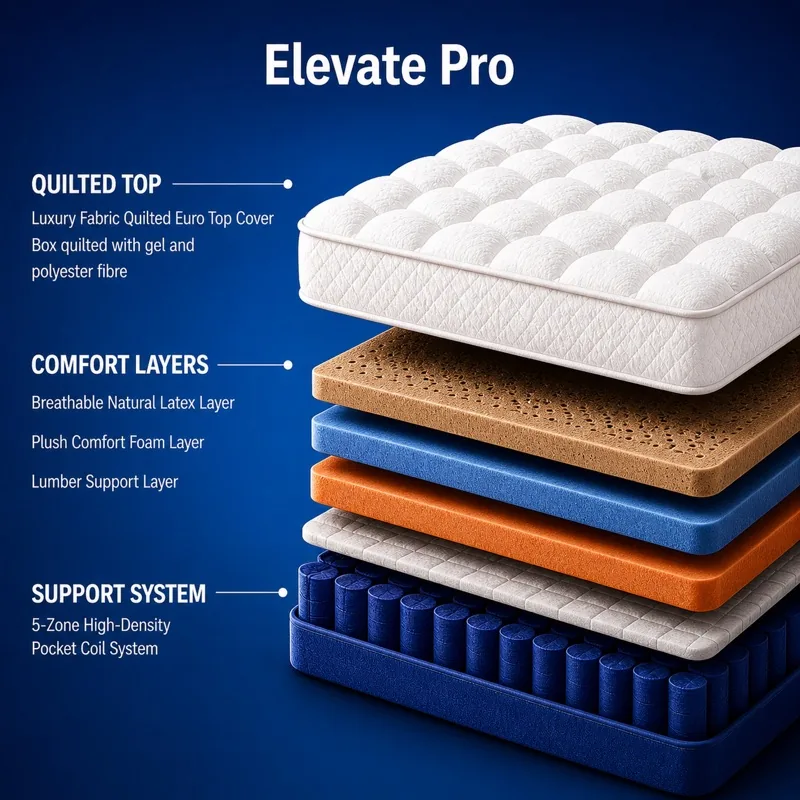
Neither is more "supportive" than the other when well-built — they simply distribute weight differently. If you want the latex feel with a lower price and quieter motion isolation, latex-on-foam is the better fit. If you sleep hot or want the most responsive, edge-to-edge usable surface available, Elevate™ is the stronger fit.
Memory-Foam Hybrid
A memory-foam hybrid pairs a memory or gel-foam comfort layer — the close, slow-contouring feel most people picture when they hear "memory foam" — with a pocket coil support system underneath, the same way a latex hybrid does. The coils add the airflow and edge support that plain memory foam lacks, without giving up the deep, body-hugging comfort layer on top. Sleepy Edge's Attune™ and Attune Pro™ both build on a 5-zone pocket coil core beneath a copper-infused or bio-based memory foam comfort layer, which is why they tend to sleep cooler than a typical all-foam mattress despite keeping that same contouring feel.
Memory Foam vs. Hybrid: Head to Head
This is the comparison most shoppers are really making, and the labels make it harder than it needs to be. A "memory foam mattress" almost always means an all-foam build: memory foam comfort layers over a high-density foam core. A hybrid replaces that foam core with pocket coils, but it can still have memory foam on top. So the real question is not memory foam or no memory foam. It is what holds the memory foam up: more foam, or coils.
| Factor | Memory Foam (All-Foam) | Hybrid (Memory Foam on Coils) |
|---|---|---|
| Feel | Slow, even contouring; you settle into the surface | The same contouring top, with more push-back and spring from the coils below |
| Changing position | Foam takes a moment to recover, so turning over takes a little more effort | Coils rebound quickly, so moving around feels easier |
| Temperature | Holds more heat; gel or copper infusions help at the surface | Open space around the coils lets air move through the core |
| Motion transfer | Very low; dense foam absorbs a partner's movement | Low with pocketed coils, which compress one at a time |
| Edges | Softer perimeter that compresses when you sit on it | Firmer perimeter, especially with a foam-encased or reinforced coil edge |
| Price | Usually costs less | Usually costs more, since the coil unit adds materials and assembly |
Choose all-foam memory foam if:
- You share the bed with a restless partner and motion transfer bothers you most.
- You like the feeling of settling into the mattress and don't mind a slower response.
- You sleep neutral or cool, and value matters more than airflow.
Choose a hybrid if:
- You sleep warm and want more air moving beneath the comfort layers.
- You change position often and want a surface that springs back quickly.
- You sit on the edge of the bed to dress, or want to use the full width of the mattress.
In the Sleepy Edge line the comparison is direct. The Ground™ (10 inches, 7/10) and Ground Pro™ (12 inches, 8/10) are all-foam, with cooling gel memory foam over a bio foam core. The Attune™ (14 inches, 6/10) and Attune Pro™ (14 inches, 6.5/10) put memory foam comfort layers over a foam-encased 5-zone pocket coil core. Firmness is a separate choice from construction, so check the rating as well as the type. Our mattress materials guide explains what each of those layers does.
How to Choose: 3 Questions
With all five types defined, narrowing down to one comes down to three questions. Work through them in order.
1. Do you want to sink in, or feel supported on top?
Foam-based comfort layers (all-foam, foam hybrid, memory-foam hybrid) give you that slow, cradling "hug." Latex-based comfort layers (latex-on-foam, latex-on-coil hybrid) push back and respond instantly instead. Neither is objectively better — it's the single biggest factor in whether a mattress feels right the moment you lie down.
2. Do you sleep hot, or run cold?
Hot sleepers do best on a latex-on-coil hybrid, and next-best on latex-on-foam or a memory-foam hybrid — anything with coils or an open-cell latex layer moves heat away faster than solid foam. Sleepers who run cold sometimes prefer all-foam's heat retention, which is usually a drawback but works in their favor.
3. Who else is on the mattress, and what's the budget?
All-foam is the most affordable type and the strongest for motion isolation, which matters if you share a bed with a restless partner. Coil-based builds (foam hybrid, latex-on-coil hybrid, memory-foam hybrid) cost more but add edge support and airflow. Latex-on-foam sits in between: latex's responsive feel without the added cost of a coil system.
Which Sleepy Edge Type Fits You?
The Sleepy Edge collection covers three of the five types.
| Type | Models | Best For |
|---|---|---|
| All-Foam | Ground™, Ground Pro™ | Motion isolation, value, dependable everyday support |
| Latex-on-Coil Hybrid | Elevate™, Elevate Pro™ | Hot sleepers; usually the coolest, bounciest build |
| Memory-Foam Hybrid | Attune™, Attune Pro™ | Contouring comfort with coil-backed airflow and edge support |
Want the close, contouring feel of an all-foam mattress? Start with the Ground™ Mattress. Want a responsive hybrid that sleeps cool? The Elevate Pro™, our pick, pairs GOLS-certified latex with a 5-zone pocket coil system. Not sure which is right? The side-by-side comparison lays out feel and construction for every model, and every order ships with a 120-night trial so you can confirm the type suits you before you commit. For a deeper look at what's actually layered inside each build — including fire-barrier materials and certifications — see our mattress materials guide.
Mistakes to Avoid When Choosing a Type
- Assuming "hybrid" always means the same thing. What sits on top of the coils — foam, memory foam, or latex — changes the feel more than the coils themselves. Check the comfort layer, not just the word "hybrid."
- Assuming latex is always on coils. As the latex-on-foam vs. latex hybrid comparison above shows, the same latex comfort layer can sit on foam or on coils, and that changes the price, the bounce, and how cool it sleeps.
- Choosing by price alone. The cheapest type in a lineup is usually all-foam for a reason, but if you sleep hot or want a firmer usable edge, the type matters more than the difference in price.
- Ignoring how you actually sleep. A plush, sink-in feel that looks great in a photo can feel restrictive if you toss and turn — match the type to your real movement at night, not just a description.
- Not using the trial. Construction affects feel more than almost anything else about a mattress, and feel is personal. Use every night of a trial period before deciding a type isn't right for you.
The Bottom Line
All-foam is the value and motion-isolation pick, a foam hybrid balances feel and breathability at a mid-range price, latex-on-foam gives you a responsive feel without coils, and a latex-on-coil hybrid is usually the coolest, bounciest option. A memory-foam hybrid keeps a contouring feel while adding coil-based airflow. Match the type to how you actually sleep — not just the label — and every Sleepy Edge model ships with a 120-night trial to prove it.
Explore the Collection →Frequently Asked Questions
Is a memory foam mattress the same as a hybrid?
No. A memory foam mattress is usually all foam: memory foam comfort layers over a high-density foam core. A hybrid uses pocket coils for its support core, and many hybrids, like the Attune™ and Attune Pro™, still have memory foam comfort layers on top. Most of the difference you feel comes from that core: coils add airflow, bounce, and a firmer edge, while an all-foam core absorbs motion more completely.
What's the difference between a latex-on-foam mattress and a latex hybrid?
Both use a natural latex comfort layer, but the support underneath is different. A latex-on-foam mattress sits that latex layer on a high-density foam base, with no coils. A latex hybrid, like the Elevate™ and Elevate Pro™, sits latex on a pocket coil system. Latex-on-foam feels closer to the mattress and isolates motion better; a latex hybrid adds more bounce, airflow, and firmer edge support from the coils underneath.
Is a hybrid mattress worth the extra cost over all-foam?
It depends on what you value. A hybrid costs more because a pocket coil support system adds airflow, responsiveness, and firmer edge support that foam alone cannot match. If you sleep hot, sit on the edge of the bed often, or want a bouncier feel, the upgrade is usually worth it. If motion isolation and price matter most, all-foam remains the stronger value.
Which mattress type sleeps the coolest?
A latex hybrid usually sleeps coolest, since natural latex has an open-cell structure that breathes better than memory foam, and the pocket coil system underneath adds further airflow. Latex-on-foam builds sleep the next coolest, since they still get latex's breathability without the coil layer's added air movement. All-foam mattresses run warmest.
Which mattress type is best for couples who move around at night?
For motion isolation specifically, all-foam is the strongest choice, since dense foam absorbs movement rather than transferring it. If both partners also want a responsive, quick-to-reposition feel, a hybrid with pocketed coils is the better trade-off — pocketed coils compress individually, so they isolate motion far better than older interconnected coil systems while still adding bounce.
Do I need pocket coils, or is foam-only support enough?
Foam-only support is enough for most sleepers and is the more affordable, quieter, motion-isolating option. Pocket coils are worth choosing if you sleep hot, want a firmer usable edge to sit on, or prefer a more responsive, less sink-in feel. Neither is more supportive than the other when built well — they simply distribute weight differently.
What mattress types does Sleepy Edge offer?
Sleepy Edge offers three construction types: all-foam (Ground™, Ground Pro™), latex-on-coil hybrid (Elevate™, Elevate Pro™), and memory-foam-on-coil hybrid (Attune™, Attune Pro™). Every model ships free with a 120-night trial and a 10-year warranty.