A queen mattress is 60 inches wide. If the outer six inches on each side slump whenever someone lies near them, two people are really sharing about 48 inches, which is narrower than a full-size bed at 54. That lost strip is what edge support is about, along with whether the side of the bed works as a seat while you put your shoes on. This guide covers how mattress edges are built, why there is no lab rating that lets you compare them, and four tests you can run in a store or in your own bedroom.

The Quick Answer
- Edge support is the perimeter's job: keeping the outer few inches of a mattress close to the height and feel of the middle when you sit or lie there.
- It matters most if you sit on the side of the bed, share it, or sleep close to the edge.
- Hybrids usually have firmer edges than all-foam beds, especially with a foam-encased or reinforced coil perimeter. Most all-foam beds have no separate edge system.
- There is no industry edge rating. The main U.S. test standard for mattresses covers firmness, durability, and height change, and its results come with no pass/fail line.[2] “Reinforced edges” describes a build, not a score.
- Your own test beats the spec sheet. Measure how far the edge drops when you sit, check a corner, and repeat during a home trial.
What Edge Support Covers
Edge support shows up in two situations. Sitting edge support is how the side behaves under a concentrated load: all of your weight on a narrow strip, with your feet on the floor. Sleeping edge support is how it behaves when you lie near the side, with your weight spread along it. A mattress can handle one well and the other less well, so it's worth testing both.
It is also a different property from the two that people usually ask about first. Firmness is how the surface feels when you lie on it, and support is whether your spine stays close to its natural line. A mattress can do well on both in the middle and still slope away at the sides. Our guide to back support covers those two, and the step-by-step guide to choosing a mattress puts edges alongside the other tie-breakers, such as sleeping warm and feeling a partner move.
Who Notices a Weak Edge
- People who sit on the bed. Getting dressed, tying shoes, or using the bed as the only seat in a small bedroom. A soft edge tilts you forward, so the side feels like a slope rather than a seat.
- Couples. When the sides give way, both people drift toward the middle and the space between them shrinks. On a queen, a few inches lost on each side is a large share of the width.
- Edge sleepers. If you sleep close to the side, a soft edge can leave you feeling as if you're about to roll off, even if you never do.
- Anyone sharing with a child or a pet who settles in the middle and pushes you outward for the night.
- People who push off the side to stand up. A firm edge gives your hands something solid to press against in the morning.
If you sleep alone near the middle of a queen or king and rarely sit on it, edge support is a minor factor. Spend your attention on feel and support instead.
Four Ways Mattress Edges Are Built
Almost every mattress handles its perimeter in one of four ways. Ask the brand or the store which one a mattress uses. The answer tells you more than the phrase “edge support” on its own.
| Edge build | How it works | What to ask or check |
|---|---|---|
| Foam encasement | A frame of firm foam rails surrounds the coil unit, so the outer row of springs is not the very edge of the bed. | Whether the rails run around all four sides and reach the full height of the coils. |
| Reinforced perimeter coils | The springs around the border are firmer than those in the middle, or there are extra rows of them. | Whether the reinforcement runs the full length of the long sides, where people sit and sleep. |
| Border wire | A steel rod runs around the top and bottom of a traditional connected-coil innerspring to hold its shape. | Press the edge down and let go: it should spring back evenly along the whole side. |
| No separate edge system | The edge is the same foam or latex as the rest of the mattress. | Sit on it. Expect the perimeter to compress about as much as the middle does. |
Foam rails come with their own vocabulary, and it's easy to misread. The Polyurethane Foam Association measures foam firmness as indentation force deflection, or IFD: the force in pounds needed to press a foam sample down by 25% of its height. Density is a separate number, the foam's mass per unit of volume. According to the association, firmness is independent of density, while density affects how durable and supportive a foam is.[1] So an edge rail described only as “high-density” is not necessarily firm, and a firm rail is not necessarily long-lasting. Few brands publish either number for their edge foam, but if one does, both are worth reading.
What sits on top matters too. Thick, plush comfort layers compress under you at the edge just as they do in the middle, so a soft top over a reinforced perimeter can still feel soft when you first sit down. The perimeter decides what happens next: whether you stop sinking once the top has compressed, or keep going. Our comparison of euro tops and pillow tops explains how each kind of top is attached to the mattress.
Foam, Latex, and Hybrid Edges Compared
Coil-based mattresses usually have firmer edges than all-foam ones, because their border can be built differently from the middle, with rails or firmer springs. In an all-foam mattress, the edge is usually just more of the same foam. Memory foam adds one more trait: it responds slowly under steady pressure, so an edge can feel fine for a second and then keep settling while you sit.
That doesn't make all-foam the wrong choice. Foam beds tend to be quieter and better at keeping a partner's movement on their side, and if you rarely sit on the bed, the edge may never bother you. Latex-on-foam beds fall in between: latex pushes back faster than memory foam, but without a coil perimeter the edge usually still gives more than a reinforced hybrid. For the full picture on each build, including heat and price, see the mattress type guide.
Four Edge Tests You Can Do in Ten Minutes
You need a tape measure and, ideally, a second person. Run each test halfway along a long side, then again near a corner, where two sides meet and the perimeter has the least around it to lean on.
- The drop test. Measure from the floor to the top of the mattress at the edge with nobody on it. Then sit on the edge with your feet flat on the floor and have someone measure the same spot again, right beside your hip. Repeat a foot in from the edge. If the edge drops a lot further than the spot a foot in, the perimeter is softer than the rest of the bed.
- The slide test. Sit right on the edge, the way you would to put on socks, and stay there for a minute. A good edge gives you a fairly level seat. A weak one tips you forward or starts to slide you toward the floor.
- The side-sleeper test. Lie in your usual position with your back a hand's width from the edge, and stay for a few minutes. If you notice yourself tensing to stay on, the usable width of the bed is narrower than its label.
- The two-person test. If you share the bed, both lie down in your normal positions and settle for a few minutes. If you each end up drifting toward the middle, the sides aren't carrying you, and the bed is working like a smaller one.
A store gives you a few minutes on a new mattress. A home trial gives you weeks, which is when an edge that is going to soften starts to show it. Repeat the drop test at the end of the first, second, and fourth week, sitting in the same spot each time, and write the numbers down.
The Bed Frame Matters at the Edge
An edge can only be as firm as what's under it. If a mattress overhangs its frame, or the side rail sits lower than the slats, the perimeter has nothing beneath it and will droop when you sit, whatever it's built from. Check three things: the frame is the same size as the mattress, the slats or platform run all the way to the side rails, and the foundation is the type the mattress maker specifies.
Height plays a part in how the edge feels as a seat, too. If the top of the mattress sits well above or below your knees when your feet are flat on the floor, sitting and standing feel awkward even on a firm edge. Our mattress thickness guide covers how mattress and frame heights add up.
Why Edges Wear Faster and How to Spread the Load
Sitting puts most of your weight on a small patch, and most people sit in the same spot every day, usually on their own side, halfway along. That patch takes more load than any other part of the perimeter. A few habits help:
- Vary where you sit, and use a chair for anything that takes longer than putting on shoes.
- Rotate the mattress head to foot on the schedule its maker gives. For ours, that is every two weeks for the first six months, then every two to three months.
- Keep the base sound. A cracked slat or a sagging center support under the edge shows up as a softer edge.
- Measure, don't guess. If one spot starts to dip, measure it with a straight edge across the bed and compare it with the impression depth your warranty describes.
For the other signs that a mattress is wearing out, and when replacing it makes sense, see how long a mattress lasts.
How Our Six Models Handle the Edge
Here is what each Sleepy Edge mattress uses at the perimeter, taken from its product page. We can't give them an edge score, for the reason above: there is no common scale to score them on.
- Elevate Pro™: 5-zone high-density pocket coils with a reinforced edge support system, under a quilted euro top.
- Attune Pro™: a foam-encased 5-zone pocket coil core with reinforced perimeter edge support, under a quilted pillow top.
- Attune™: a 5-zone pocket coil core, foam-encased for edge support, under a quilted pillow top.
- Elevate™: 5-zone high-density pocket coils under a quilted euro top. Its product page doesn't list a separate edge system.
- Ground™ and Ground Pro™: all-foam, with foam support cores and no separate edge system listed.
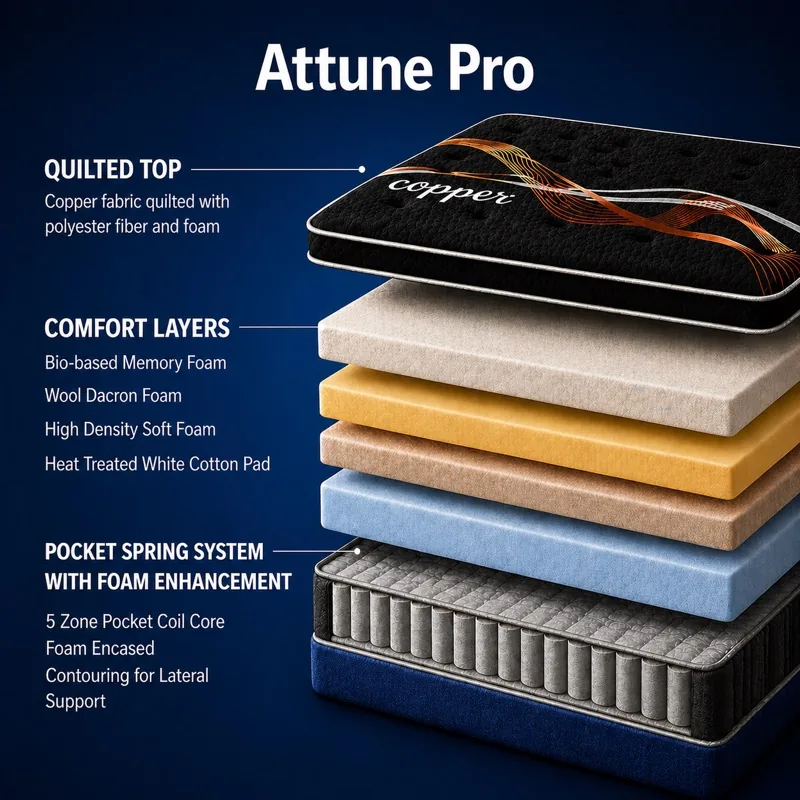
If sitting on the side of the bed or sharing it is high on your list, the Elevate Pro™ and Attune Pro™ are the two with reinforced perimeters, and the Attune™ has a foam-encased core. Whichever you choose, run the drop test in your own bedroom: take 120 nights to decide (we ask for at least 30 to adjust). If it's not the one, we'll pick it up and refund your purchase, minus a $99 processing fee.
The Bottom Line
Edge support is about usable space: how much of the mattress you can sit and sleep on, not just how the middle feels. Ask how the perimeter is built, remember that “reinforced” isn't a measurement, and trust a tape measure over a label. Check that the frame holds the mattress out to its edges, and vary where you sit so one spot doesn't take all the wear.
Frequently Asked Questions
What is edge support on a mattress?
Edge support is how well the sides of a mattress hold their height and shape when you sit or lie near them. Good edge support keeps the outer few inches usable, so you can sit on the side without sliding forward and sleep near it without feeling you might roll off. It is a separate property from firmness and from back support.
Do memory foam mattresses have good edge support?
All-foam memory foam mattresses usually have softer edges than hybrids, because most have no separate edge system: the perimeter is the same foam as the middle. Memory foam also responds slowly, so an edge can keep sinking for a moment after you sit down. Some foam beds add firmer foam at the sides, so ask, and then sit on it.
Which type of mattress has the firmest edges?
Hybrids with a foam-encased or reinforced coil perimeter usually do, because the border can be built firmer than the middle. There is no industry edge rating to compare them by, though, so two hybrids that both say "reinforced edges" can feel quite different. Sit on the edge and measure how far it drops.
Why is my mattress sagging at the edge?
The usual causes are sitting in the same spot every day, a frame or foundation that doesn't hold the mattress out to its sides, and soft comfort layers compressing over time. Check the base first, then rotate the mattress and vary where you sit. If the dip keeps growing, measure it and compare it with the impression depth your warranty covers.
Does a pillow top make the edge feel softer?
It can. A thick, plush top compresses when you sit on it, at the edge as much as in the middle, even when the coil perimeter underneath is reinforced. The perimeter still matters, because it decides whether you keep sinking once the top has compressed.
Does edge support matter if you sleep alone?
Less. If you sleep near the middle and rarely sit on the bed, the edges seldom come into play. It matters more on a twin or full, where the outer few inches are a bigger share of the space you have, and for anyone who sits on the side to get dressed.
Sources
- Polyurethane Foam Association. Foam Performance (definitions of IFD and density).
- ASTM International. ASTM F1566-14: Standard Test Methods for Evaluation of Innersprings, Boxsprings, Mattresses or Mattress Sets (scope summary).